 |
| Entering Azerbaijan's Caucasian paradise |
14.6.25 Baku
Sitting on the north-facing balcony of our apartment, on Baku's Tolstoy Street, there are dozens of old-style houses, many with enclosed balconies. Ringing them are the big new blocks of flats that are springing up everywhere in Baku, a city in rapid evolution. To my right, another building is going up. I see a worker balanced perilously on a single plank bridging two flimsy scaffoldings. A slip would mean certain death. To the south, the Caspian Sea, the first time I have seen it from ground level. Such an anomaly, this huge body of water, sadly now drying out, just like the nearby Aral Sea. Hundreds of swifts swoop through the morning air, catching their breakfast. It’s going to be hot today.
 |
| The view from the ninth floor |
The journey here yesterday was easy but fraught. Easy because it was direct flight from Gatwick to Baku on the national airline. Fraught because we were flying in a Boeing Dreamliner, the day after a similar plane crashed in India, for no obvious reason. Fraught, because the day of our flight, that madman Netanyahu decides to attack Iran – just a few hundred kilometres from here – risking a war in the region. Well, yesterday was Friday 13th, so I suppose it makes sense.
Baku airport very modern, rather nice, and efficient. The usual photos at passport control, then a short wait for our bags, then out to find our driver, Akif. Confusingly, his mobile phone was from Uzbekistan, so I asked if he was Uzbek. He said he wasn’t, but that his phone number was, without explanation. He had a little English, but spoke Russian well – he said he had been in the army. He was 55, with grizzled hair and a rather careworn face. But he had turned up on time, and drove well, so I asked whether he might be able to drive us to Qobustan, where we wanted to see the petroglyphs, on Sunday. Seems a possibility.
Lots of traffic during the drive in from the airport, which is about half an hour from the centre. Broad roads, which were all artistically illuminated as we entered the city, now in darkness. The numerous buildings from the early 20th century in the Italian style made the place look like Italy – specifically, Sicily. The traffic jams and bad driving similar too.
We got to our flat here, which was not the one we paid for. The other apartment, which gave onto the boulevard by the sea, had “technical problems”, unspecified. I spent much of Thursday arguing with the owner of Bakapart – which seems to have dozens of properties in the capital – and trying to get something nearer the sea. Tolstoy Street isn’t, but it is central, near Fountains Square and the old city. It also has a 24-hour supermarket next to it, which is pretty damn useful. When we get to the flat, we find the wifi isn’t working (but our eSIMs are, so that’s not too much of a problem), and the dishwasher wasn’t plugged in, because the electric cable is too short. I managed to get it working by moving the fridge and angling the dishwasher to get it closer to the socket under the sink. At least the aircon is good.
Sitting on the boulevard beside the Caspian Sea. The Caspian. Amazing. Walked down here from our flat to Fountains Square. Very peaceful, few people about. A bright yellow trailer marked shah döner has ethnic music playing, filling the morning air. Lovely sea breeze here.
 |
| The boulevard along the Caspian, and the famous Flame Towers |
To my right, the famous Flame Towers, and on the front, the eight-petalled Sydney Opera house lookalike. To my left, the striking Polo mint building, with its huge hole in the middle. Nearby, lots of new office blocks, flats and shopping centres. Pleasant just to stroll, to sit, to stare. Back to Fountains Square, then here, Fisincan Restoran. Cool, and with a good view of the Armenian church in front.
Out on the balcony, the wind is surprisingly strong – this is the other Windy City. Swifts taking a quick snack…
After lunch, back to our flat, where I was busy organising our big trip into the Caucasus. This involves some logistical choreography. A taxi form Baku to Quba, which is one of the main towns in the north of the country, not far from the border with Russia/Dagestan. After lunch in Quba, another taxi needs to take us to Khinalug, one of the highest inhabited villages in Europe. There we stay for three nights, before reversing the choreography – Khinalug to Quba, Quba to Baku. Organising the taxis was one thing, the other being finding how much they would cost, since I need to pay in Azerbaijani manat. And that means extracting local currency from ATMs. As in Kyrgyzstan, the ATMs limit the max withdrawal – in this case to 200 manat – about £100. That means multiple trips to the ATMs.
After that housekeeping, out again to Fountains Square – where amazingly, the fountains were working, unlike this morning. Also unlike earlier, the square is full of people. Lots of young people wearing sashes with the words “Graduate 2025”. Restaurants full of groups – it is striking that they tend to be single sex – all men or all women. One road was closed off for what looked like a street party/feast.
 |
| The Maiden Tower in the old city |
This time we went to the Old City, passing up stone steps, then on past the Maiden Tower. A completely different atmosphere reigns here. The roads and lanes twist confusingly, unlike the straight streets around Fountains Square, most of which are arranged on a grid. One thing I had not appreciated when looking at maps and descriptions of this ancient area was how hilly it was: the paths often rise quite steeply, adding a three-dimensional aspect to the maze. It felt like I was in Venice, where streets would swerve madly, and apparent dead ends continued their way – except it was anything but flat. It gave an extra richness to this dense, interesting space.
 |
| A minaret in Palace of the Shirvanshahs |
The architecture was striking too. A variety of older styles were thrown together, in a rather pleasing way. Some of the buildings were very strange. As we rose, we could see the flame towers nearby, as well as beautiful views across the Caspian to the east. At the top there was a mosque, and near that the Palace of the Shirvanshahs. We did not go in, because it is one of the few monuments open on a Monday, and we will see it then. We sat in a small park near the palace, tall trees providing welcome relief from the sun, still hot. In general, Baku has done very well with its tree planting – apparently there were few of them until recently. Similarly, the main promenade by the sea is full of high trees, making a stroll doubly pleasant. And all this on reclaimed land.
15.6.25 Baku
On the way to Qobustan State Historical and Cultural Reserve. Very windy – from the north, so surprisingly cool. Not sure how swifts cope… Air clearer today – the wind, presumably. Not much traffic. Lots of new apartments being built. Also noticeable the use of sandstone for many buildings. To our left, a few nodding donkeys, nodding slowly away. Passing the Bibi-Heybat Mosque – two minarets, two domes. Unusual design – wide and thin, with mirrored windows. Sea quite choppy.
Speed cameras on the road – our driver, Akif, slows down… When we got in, he said that he sent me message: Which was an odd thing to do, since he could give it to me verbally. I had a look and it said:
“Yes, I am already responsible for you. I have to take you and bring you back safely, so that nothing happens to you. Inshallah I am responsible for you before God, so do not worry. Everything will be fine. Everything is good. Everything is great.”
Nice touch. He also seemed to be saying a prayer before we set off. Obviously pretty religious.
A sign on the road saying “Evakuator 156” just like in Kyrgyzstan. A police check, pulling in cars… Not us this time. A strange, very tall metal construction by the docks – looks like an oil rig, with platform at its base. Huge. Even the roadside walls made from sandstone – presumably mined locally, and cheap. On the wide main road – eight lanes (four plus four), good quality, but max speed 90 km/h. Wind is whipping up dust and sand…
To our left, two oil rigs close to land. Max speed 110 now. A roadside cafe advertising showers. Baku shipyard to our left, with a half-built ship. A van in front has its number plate painted larger on its back door – as in Kyrgyzstan. Fields of solar panels – rather dusty, since they are next to a big cement works…
Passed several lorries carrying blocks of sandstone – like large bricks. Quite a few police checks along here. Our driver’s map app gives a warning – in Russian. Huge wall of sandstone alongside the road. Turn off the main road, through rather grim, dry landscape. Houses, shops, but few and depressing.
 |
| Just a few of Qobustan's many petroglyphs |
In the petroglyph museum – new, well laid out. To the petroglyphs themselves. Lots of signs saying: “beware of the snakes”. Quite a few tourists. Impressive the quantity of petroglyphs, and the perseverance of the artists. Kudos to them, too, for choosing such a beautiful site – a big rocky outcrop in the middle of a barren plain. The rock the same sandstone found in Baku – the national stone. Easy to carve, obviously.
 |
| Qobustan's barren plain |
The warning about the snakes quite justified. At one point, I was looking at some petroglyphs and there was a small-ish vipery thing sunbathing on the rock above me. The site well designed, with paved paths leading from rock art to rock art. The view from the end of the circuit over the scorching plain below was dramatic.
 |
| Bibi-Heybat Mosque |
Halfway back, we passed a really bizarre structure – emerald roof, pagodas, very Baba Yaga. A rich man’s villa, our driver tells us. Hideous. Driver just showed us his battered phone – his “war phone” from the Nagorno-Karabakh war (not sure which one)… Stopped briefly at the Bibi-Heybat Mosque to grab some pix.
 |
| Baku's Government House |
Out in the afternoon, for a walk along the promenade. Very windy – feels like an English seaside esplanade. Lots of people out, strolling. Air much clearer, thanks to the wind. Along to the weird Government House, rather spoilt by the Formula 1 stands blocking the view. Lovely dusk, with a strange feeling of autumn. Baku really is somewhere else, where the usual rules don’t apply.
In SAHil restaurant. Upmarket, with a good range of dishes – huge menu felt like a heavy medieval book from some chained library. Vaguely ethnic music – poppy but local. Quite quiet at this time. Wind still very strong, good to be inside. Had Georgian badrijani rolls, and qutab with pumpkin. I’ve ordered the Shah pilaf. Bread particularly good – all five types. Plov came en croûte – nice idea, but since I had the veggie version – no lamb – it was rather dry. Ah well…
 |
| Swanky Baku |
After the meal, walking north past Sahil metro, we entered the swankier part of Baku – designer clothes shops etc. Lots of money here – oil money, something that neither Armenia nor Georgia has, and it really shows in their capitals. Here, new buildings are springing up, old ones renovated. In Armenia and Georgia, it’s mostly old stock, and it’s not being repaired properly. Sad. Passed through Kaghani Garden – full of people, out for an evening walk – in the by-now rather chilly wind. Must take a jacket when we go out tomorrow for the mugham concert at 7pm.
16.6.25 Baku
At the top of the Maiden Tower. Strong glass stops anyone doing anything stupid. Lots of schoolchildren, taking pix. Wind quite strong, but less than yesterday. Overcast, but sun peeking through from time to time. Warm but pleasantly aerated. Good view of the Mugham Centre. Flame Towers prominent. Three minarets visible in the old town, including by the palace. TV tower reminds me of Almaty. From here, you can see how the ground rises from the shore.
 |
| A dervish's bag for collecting small things |
Before here, in the old city, at the Palace of the Shirvanshahs. The palace itself largely reconstructed, and a bit thin on contents inside. The best exhibit had the intriguing caption: “dervish’s bag for collecting small things”. But there are several other parts to the complex that are worth seeing. Various tombs, reminding me of those in Samarkand, mosques, some of which look like the buildings in Sarajevo, the palace mausoleum, and the Divankhana. Good views towards the flame towers. Wandering from the palace back along some of the streets we followed on Saturday, I had a distinct feeling of Venice, adding to the charm of the place.
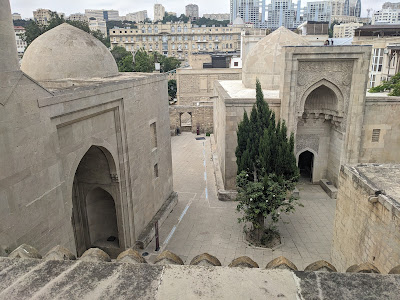 |
| A mosque and mausoleum inside the palace walls |
Before our mugham concert, along to Deniz shopping centre – huge, rather empty inside. Lots of familiar brands, plus something unusual – a pair of slides from the upper floors for children. Now in Vətən restaurant there, with real folk music playing as background (not live, though). Sounds like a dombra (?). Decor rather spoilt by the bare concrete roof visible above us.
In the palace this morning there were parts of a wall pockmarked by bullets. The explanation was quick to attribute this to Armenians massacring Azeris a century or so ago. Another part, by the mosques in the palace, did the same. Not seen it mentioned much, but it’s there in the background.
Food here a disaster: half of our order doesn’t turn up, my plate is so cold it chills the slightly warm food, and the chicken on it had clearly died of malnutrition. Come to think of it, eating chicken before going to the mountains is pushing my luck…
 |
| Baku's carpet museum |
Anyway, along to the Mugham Centre for tonight’s concert, a celebration of the great Azeri musician and pedagogue, Mahmud Salah, on his 65th birthday. We passed the unmistakable carpet museum – shaped like a rolled-up carpet – along the way. The Mugham Centre is a beautiful modern building – barcode scanning of tickets to get in – and famously designed in the shape of the Azeri tar. The entrance hall has dozens of marble busts of Azeri composers plus a few ethnic instruments, some quite old. Then through to the body of the architectural tar instrument, where people are milling around before the concert. The man himself, Mahmud Salah, was there, being interviewed by Baku TV, which I have been watching before coming to the country. Lots of local worthies around, it would seem.
 |
| The Mugham Centre, shaped like a musical instrument |
The concert began late, partly because of the interviews. We filed into a beautiful hall, wood everywhere, plush leather seats, and lots of legroom. Many people were carrying flowers, obviously for the great man. Quite a few children too, a good sign for the future of Azeri culture. The concert had too many speeches for my taste – largely incomprehensible – plus lots of video recordings of mates wishing him well. Some in Russian, some even in English.
Most of the music making was by his pupils, who took turns to play the daf, a frame drum. The other instruments were a piano, two tars, oud, hammered dulcimer, and the kamancha spiked fiddle. His pupils sang as well as played, as is customary for the daf player in mugham. Many very good. The exception to the rest of the programme was a trio of female singers performing a piece that sounds almost Georgian in its striking harmonies.
 |
| Mahmud Salah, showing how its done on the daf |
The climax of the evening was of course the man himself doing a spirited solo, plus one with the pianist (his son? Grandson?), and a final one with all his pupils. His playing was fantastic, and in a different class when it came to virtuosity and variety. Overall, despite the longueurs, it was a really special and splendid experience to attend. Nice too to see all the flower and gifts – including a carpet with his image – and various awards.
17.6.25 Baku
In the taxi on the way to Quba, en route to Khinalug. Taxi driver had trouble finding us – few numbers on buildings here. Since he doesn’t speak English or Russian, I’ve had to switch my brain to Turkish, which was tricky at first. On the main road to Quba, people weeding the verges. Earlier, a man was watering shrubs from a water tank. This morning, when I went out to more cash, the stones of Fountain Square were wet – washed, it seems.
To our left, low hills, with red rocks (iron, presumably). Wind turbines at the top. Road flat, quite good. Lots of speed cameras, and a few cops. As we join the motorway north, a road sign indicates 202 km to Derbent...ah, if only. As we bowl along at 130 km/h, a man on a bicycle rides in the opposite direction in the fast lane by the barrier.
Turning off the almost deserted motorway onto the local road to Quba, the roadside gas pipes appear – something almost absent in Baku, but omnipresent in Georgia and Armenina. A few donkeys by the side of the road, but no dogs. As we drove out of Baku, there was one sad-looking stray, but that was the first I’d seen. Quite a few stray cats.
 |
| A street in Quba, as seen from the Lucky Restaurant |
Now in the Lucky Restaurant – the point of rendezvous where our second taxi will pick us up. The driver is the father of our homestay host – just as in Kyrgyzstan, where our driver for Song-Köl was the dad of our host in Kochkor. This place is big, open 24 hours, and has a non-smoking section for families. But it’s not closed off, so smoke naturally drifts. Striking that here, as in Baku, the toilets all have bidet showers as standard. Very civilised. Food not bad; bread good, as ever. It’s noticeable that there are far more Ladas here. In Baku by contrast, there are lots of flash jamjars – Chinese ones, and plenty of electric ones too.
Now waiting on the mountain with Bayrum Kulu, our driver, and the dad of our homestay host, Izzet. In front, a lorry is stuck on the steep road we need to take. They are currently trying to dig it out, putting gravel under its spinning wheels, unable to get a grip on the muddy road.
Journey from Quba was amazing, not least because it was in two distinct parts. For half an hour, we passed 12 to 15 hotels, dozens of restaurants. Already very developed there, beautiful, but tamed, rather like the landscapes around Lake Garda. Then suddenly, through a narrow gorge and we are in a wild, beautiful country. Stone walls rising hundreds of metres, a deep valley. It’s raining, but that adds to the beauty. After the narrow gorge, some stunning rock formations. Beyond, a long road was visible, rising, rather like the one that led to Song-Köl in Kyrgyzstan.
 |
| Beyond the gorge, the road to Khinalug |
Because of the broken bridge here, we had to drive across the river bed, ford the river, and then drive up a steep bank. The lorry finally moved, and we were able to descend along the road it had blocked. The bridge was being rebuilt with two concrete walls, but there a huge gap from the old road, which had been swept away with the bridge by the immense force of the river in spate.
 |
| A river to ford, a blocked road to clear, a broken bridge to circumvent |
Past Eagle Nest – one of the best views when sunny, but now shrouded in clouds. Beyond, the air cleared slightly, showing a valley, striking in its greenness, as is everywhere here. Then a long, long road following the river upstream. The river bed is a great fractured sheet of black, from the rocks, broken up by rivulets. This part reminded me of Darial gorge in Georgia, but here was much wider and grander. The mountains opposite were covered in folds of green, like velvet.
 |
| The river in its broad bed |
At the end of this section, Khinalug was visible on the hill to our right. We drove into the village, then down a vaguely dodgy track to here, Izzet’s Riverside stay. Our accommodation exceptionally comfortable for the location – it even has a bathroom with toilet and shower. The view from the window of the adjoining bedroom everything you’d hope it would be: across the river to the high peaks of the Caucasus mountains opposite. Stunning.
 |
| Room with a view |
After a short rest, out and down to the river behind our rooms. Some rain, but also sunshine, which casts long shadows on the rounded mountains behind us. The faces are not flat, but have a layered effect, like rice paddies, but shallower. Maybe caused by the constant movement of the grazing cows, visible in the distance.
 |
| Welcome to the neighbourhood |
Standing on the rocky bed of the stream below our homestay, we meet a group of three donkeys, shaggy, still, surveilling. On the other bank, a large-ish dog runs – protecting herds, I imagine. I hope not too savage, like some Caucasian shepherd dogs can be…
Along the path that follows one of the streams running down to the river, before leading up to the village. A small herd of calves being led here; ditto some newly-shorn sheep, and goats. The higher mountains behind the village catch the sun, and remind me of the Mont Blanc range. Amazingly, the sound of jet planes can be heard here: several commercial jet liners have passed overhead, heading eastwards. Et in Arcadia ego…
 |
| The view north |
To the main building of our hosts for supper. We took the wrong route, ended up in the cow stall. Bayrum ate with us, while Izzet and his wife (and Bayrum’s wife) stayed discreetly out of sight, preparing and bringing the food. This was home-made cheese and yoghurt, provided by the family cows. A vegetable soup, home-made bread and dolmas, but the Azerbaijani variant, formed with cabbage leaves. All washed down with black tea.
Bayrum loquacious as ever, asking questions about us – and me returning the favour. He learnt his Russian in the army, and served in Vladivostok - -30°C in the winter, but they had good clothing and boots, he said. He has three sons – 36, 34, 32 – of which Izzet is the youngest. There are six grandchildren, four boys, two girls. Izzet and his wife have a boy, Altai, named after the mountains, who is now four.
Bayrum’s oldest son lives in Quba, where Bayrum is helping to build his house. Bayrum says that he (Bayrum) married late at 28, because he wanted to earn money for his marriage first. Usually, men marry when they finish military service, which is for 1.5 years. Generally, they are 23, 24. Women marry after secondary school or university. He married late because his fiance’s father was dead, and couldn’t offer the traditional dowry. He said fathers typically buy household goods for the new home – TV, cooker, crockery etc.
Our conversation drifted to wars, and then the wars with Armenia. Bayrum showed a certain, er, negativity towards Armenia, which he claimed was a country invented by the Soviet government <sigh/>. He did say that all wars were bad, so there’s that.
Today has been truly remarkable. Fro the early problems of trying to locate our taxi, who couldn’t find our address. Followed by his rather madcap driving at 150 km/h on the splendidly new and empty motorway. Then the rather surreal experience of eating in Lucky Restaurant, which was huge and practically empty. Meeting Bayrum, with his battered Niva 4x4, a fetching scarlet colour. Not only did this not have seat belts in the back – and neither did our first taxi – but the ones in the front didn’t click into place. We wore them wrapped around ourselves to keep the police happy if they took a look as we passed.
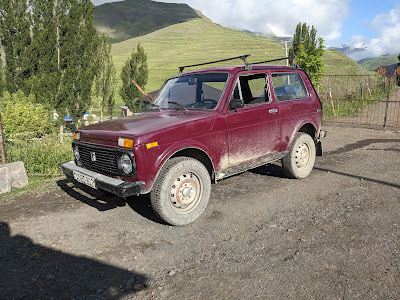 |
| Bayrum's trusty Niva 4x4 |
Then we had Bayrum’s driving up to here. This included going pretty fast on all roads, and culminated in a drive across a river where the bridge had been washed away – leading to a muddy road where the lorry was stuck on what Bayrum helpfully called the “road of death”. But he was quite happy to stop repeatedly so that we could take pix of the utterly stunning views, wonderful even under intermittent rain.
And what unforgettable sights they were. They reminded me of my journey to the Yaghnob valley, but were arguably even more impressive, because on a much larger scale. These mountains were, after all, the Caucasus. As in the Caucasus. It’s hard to grasp that we are really here, a mere few days after arriving from London. Indeed, Bayrum’s wife did ask what people from London were doing here. We’ve not yet seen Khinalug village itself, but the “outskirts” are glorious. And even though the modern world is creeping along the road to here in the form of mass tourism, Khinalug is still a unique glimpse of an ancient and timeless way of life. We are privileged to catch it before it vanishes.
18.6.25 Khinalug
Had a great night’s sleep, despite the braying donkey outside our window. Woke to low cloud, which is now lifting, as the sun breaks through, making the rich grass glow green. Last night, when we went to bed, Bayrum asked us if we wanted some water. He took a pitcher, and filled it from a hose outside the main house. He said the pipe went 2 km up into the mountains to provide the purest water.
 |
| Our ex-Soviet transport to the waterfall |
Standing now by the Khinalug waterfall, the water roaring beside us. Insane journey in a big Soviet army truck to get here – metre high wheels, needed to cross the river 10-15 times – sinking worryingly deep every time. Thrown around madly on the way – my back bruised, my kidneys none too happy. Valley totally unspoilt, beautiful. Dotted with wild flowers – my favourite the orange poppies. Also lots of what looks like poisonous hogweed. We left the truck about two kilometres from the waterfall, and walked the last part. Slightly slippery, but worth it. Air so pure here – like the water.
 |
| The view down the valley towards Khinalug |
Rock formations wild – vertical strata, where it has been twisted through time. Our host/guide Izzet pointed out one of the old silk roads, used by Albanian merchants (the other Albania, obviously). Tough journey…
(How can I remember this day and its experiences? Pix, yes, this book, yes, memories...but still incommensurate. This is what we came for…)
Sliding and falling – we walk back to the truck. Izzet tells me about the bears and wolves. The latter not only carry off sheep around here, but sheep dogs too. In winter, they hunt in packs of 20… Now drinking tea prepared with a samovar, sitting in the lee of the wind by one of the valley’s rock cliffs. The river, a muddy olive colour, runs fast below us.
 |
| Izzet's museum occupies the left side of the white building |
Sitting at the top of Khinalug itself, by the Jami Masjid. Before I climbed up here, we walked to the village, to visit Izzet’s museum. On the wall by the door, a chart of the sounds of the local Ketsh language – all 49 of them. Many like the weirder ones of Georgian.
 |
| The crazy, wonderful Ketsh language |
Opposite, a map of the traditional “Köç Yolu” transhumance route from Khinalug to a village at a lower altitude (Khinalug lies at about 2200 metres), some 200 km away. In the small museum – an extreme depth of time on display – from 5000 BC through Bronze Age, Persian empire, Romans, Byzantines, Arabs. I never knew that Khinalug was so old. You can see why it has been inhabited for so long: a hilltop village, easy to defend, hard to take.
 |
| Khinalug viewed from its highest point, looking south |
Walked up to here, through a real maze of alleys. There are no roads inside the village, just mud tracks. Houses small and quite poor. Lots of cows, chickens, turkeys, goats. Big piles of stacked dried dung bricks, ready for burning. Also one optimistic girl trying to sell something to us – hats, tea. Sitting here, feeling the earth move (no, literally – is it possible with the strong wind?), I begin to feel that maybe this place knocks Ushguli into a cocked hat, at least in terms of everything that I have read about Georgia’s highest inhabited hamlet. This village's history is longer and more varied, and the scenery more spectacular, because it’s amazing in every one of the several valleys around here. We only saw one close up today, but there are many others, plus some high mountains. Smell of smoke rises up to me as the sun sinks towards the mountains opposite. I had better be going, before this bit I am sitting on gets blown away…
 |
| The top of Khinalug, seen from lower down, looking north |
Walking down the other side of the village (to the south), lanes noticeably more dusty, fewer bits of greenery than to the north. The poor part of town? Good views of the houses from lower down. They have a Himalayan feel to them. On the way to the village, two huge Caucasian eagles swooped above us – really wide wingspan. I managed to take a pic with one eagle and a jetliner, the modern techno-eagle.
After supper, waiting, then out to see the stars. We are blessed with a clear sky. Myriad stars visible – far more than in UK or most other places. A few planes and satellites visible. Would be a great location for a telescope here…
19.6.25 Khinalug
Awoke to stunningly sunny morning. Deep shadows on the mountains. Yesterday, I asked Bayrum whether he spoke Ketsh, and he said everyone in the village did, but he lamented that many young people preferred to speak in Azeri. And I stupidly realised only then that the reason I had been unable to understand his shouts to his daughter-in-law and wife in the nearby kitchen was because he was talking in Ketsh.
We hope to go horseriding today, and I also need to organise our taxis for tomorrow, which will see a reversed takeover in Quba. With luck, we will have better weather for the trip back than when we came, and will thus be able to take pix of the dramatic scenery along the way.
 |
| Have horse, will travel |
Out for a short ride. Nothing adventurous – essentially, along the first part of yesterday’s route to the waterfall, but made more interesting by the fact that we rode without stirrups. The saddles were also much softer and broader than European one, much more comfortable. Things were also improved by having an obedient horse – unlike the one I rode in Kyrgyzstan, which was lazy. A good deal at 80 manat for an hour. Our truck driver yesterday cost 70 manat.
 |
| Fresh bread from the family təndir |
As we went to lunch, our host called us to follow him. He took us into a small outbuilding, which turned out to be the household bakery. In one corner was a təndir, with Izzet’s mother slapping the bread dough onto its hot walls, and taking out the cooked bread. A few minutes later, we were eating it, still warm. Similarly, we have been drinking milk from the family cow, and eating yogurt and cheese made from it. You don’t get fresher than that. Everything delicious.
 |
| Lower Khinalug village, with beehives, and fleece out to dry |
After lunch, a rest, then out for a walk. We take the lower road to the village, then cross the stream on a short bridge. Climbing up the hill gives a fab view of Khinalug and its valley. The mountains behind in the clouds, but the village clear. I can see the Jami Mosque whose roof I stood on to take a view across the valley to here. Two rows of beehives by the stream, but honey won’t be good until autumn because bees need flowers for a while. A house opposite has a couple of dozen fleece out to dry. To the right, our homestay is visible, more mountains behind, clouds tumbling in a valley. Glorious.
One of the amazing things about Khinalug is how different it is from my poor imaginings. I thought there would be a couple of roads, as in a small Italian villages. I also visualised it as much flatter. Instead, it was a spider’s web of muddy tracks weaving in an out of small houses and gardens. And the way up is steep: it’s a serious hill. Doubtless those in Dagestan used by Imam Shamil as his strongholds were the same. Khinalug changes my perspective, and in a good way.
One thing that Izzet told us at the museum is that the traditional houses here are built from stones taken from the nearby stream. When a couple is married, the whole village forms a human chain from the water to the village, and passes suitable rocks up one by one along the chain. That must be quite a sight… and a wonderful symbol of what makes this place special – and what we have lost elsewhere.
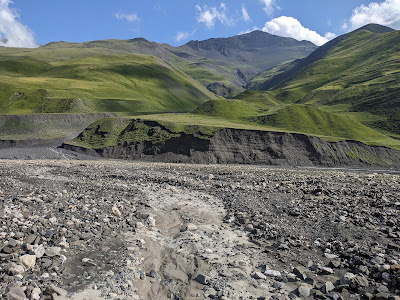 |
| The remains of a Roman fort, apparently |
Opposite us, on our right, above the main river, there are a few ruined walls on a hummock. Izzet (the historian) tells us this is – unbelievably – the remains of a Roman fort. Imagine the thoughts of the legionaries stationed here, in winter. Reminds me of the similar thoughts that I had when I drove up Hardknott Pass with its 1 in 3 road to the Roman fort there. Forts at opposite ends of a huge empire, now just piles of stones for us to wonder at…
Walking across the dry river bed behind our accommodation, the wind blowing quite strongly, I pick my way among the stones. It feels like a Cornwall beach.
For our final supper, we were given kebab – in this case, barbecued chicken. And then, as I feared, the alcohol was brought out – which turned out to be Azerbaijan’s finest 7-year old whisky. Bayrum did not approve of me sipping this, but hey… Then a long conversation about grandchildren (again), and the duties of parents and children – all very traditionalist. Pretty much as you would expect in this rural community. Afterwards, as I filled my jug with water from the mountain I encountered him again, leading a lamb which he was feeding with a bottle of cow’s milk. Its mother had died apparently. And the work of looking after the animals never stops…
20.6.25 Khinalug
Woken this morning by the light and the lowing cattle as they were driven out to the fields on the mountains. One doing so is Bayrum, up early, as usual, working, as usual. The other day he showed his room in the main house. It was sparsely furnished: a mattress on the floor, carpets, a religious text on the wall (in Arabic, of course). The dining room is similarly bare: just a large rubber plant, plus a TV screen, hooked up to the satellite dish outside. Satellite seems to be big here – literally and metaphorically. In Baku, the view from our apartment over the old quarter showed hundreds of these mushrooms, mostly rusty, pointing in one of two directions.
The main house here has an outside squat toilet, between the bakery and the chicken roost. It was following visitors’ complaints about the rudimentary toilet facilities that the bathroom was added to the room we are in. With a hot shower and Western-style toilet, it rates as luxurious now. Although worryingly, using the shower just now, I was getting electric shocks from part of the shower head – rather worrying when you are wet…
Today we end our idyllic sojourn in paradise, and head back to Baku (sic) via Quba. It has certainly been a wonderful experience here, but I fear this place may not survive in its uniqueness for long. Yesterday, a group of Poles bowled up in two big cars, rented presumably, and asked to park in this property while they went for a walk. For some reason, Khinalug is popular with Poles, who form the majority of tourists staying in this homestay, apparently. Word is getting out, and with the decent road all the way from Quba, it’s pretty easy to get here now (at least in summer). We already saw dozens of hotels on the first stretch of the road from Quba, and it’s not hard to imagine Swiss-style chalets and hotels being built here in Khinalug. You can’t begrudge the local population the chance to have a better life through tourism, but something valuable will be lost. Let’s hope at least Ketsh is preserved.
The air is preternaturally clear this morning. The peaks of the mountains outside our window are of an unbelievable sharpness, especially the higher sections that are bare rock. We left around 10.30 am, back in Bayrum’s battered maroon Niva, with its constant smell of fuel and exhaust fumes. The journey back was tinged with melancholy, because we were leaving, but redeemed by the weather. On the way in here, low clouds and rain had obscured most of the views. Now the sky was a brilliant blue, and the air without a hint of haze.
We passed back along the road that followed the river and its huge, grey bed, with only a few channels full of water. The mountains opposite seemed empty of non-natural features. At the end of this valley, the road rose quite steeply, and came to Eagle Top, marked by a stone eagle bedaubed with graffiti. The view south west showed the road we had passed along. The valley below extremely deep, as was the north east side, where the road we were about to take snaked away over a hill.
 |
| The view from Eagle Top, back along the road to Khinalug |
Following the road over that hill took us into the next valley, where there lay the village of Cek (pronouned “Jek”). Descending past it took us to another river – the one that had recently destroyed the main bridge over it. On the way in to Khinalug, we had witnessed a lorry struggling to ascend the road made muddy by rain. No problem for us on the way out now that the sun had turned the mud to dust.
 |
| Cek village |
We crossed the river, and began another ascent. The rock formations around here are incredible: bare mountains jutting out impossibly, steep streams and their beds flowing down, a great crumbling wall of rock, and beyond, a small level area leading to the gorge that acts as an entrance to Khinalug and its wondrous lands.
 |
| The mysterious temple |
Just before the narrowing of the gorge, there is one of my favourite sights on this journey: what to my eyes seems an impossibly large temple, with thousands of pillars supporting dozens of platforms. In reality, the rock here had been eroded horizontally and vertically, creating column-like structures that reminded me of Fatehpur Sikri, but on a colossal scale. At the right-hand end, there was what seemed to be a huge tower, as in a medieval castle, and smaller turrets along the top of the “temple”. Just awe-inspiring, especially when you think of the millions of years of geological processes required to carve out these shapes.
 |
| The gorge and its waterfall |
The “temple”, formed of red rock of the kind found in northern India, leads to granite walls that drop precipitously from the top to the bottom. This is the gorge, through which runs the river. There is also a small waterfall, emerging from lower rocks covered in rich greenery. The gorge narrows to a tiny V-shaped cleft, through which blue sky and a few high clouds were visible. Inevitably, this form reminded me of another narrow and forbidding entrance into another world – that at the head of the Yaghnob Valley, which is even more isolated than Khinalug, but not as varied in its geography – or history.
Passing through this protective gorge to the north west cast us rudely out of paradise, and back into a world of hotels and commercial exploitation. The scenery was less interesting here, even though nicely wooded. Passing through place with splendid names like Qırızdəhnə, Küsnətqazma, Qımılqazma and Qəçrəş, we were soon in the outskirts of Quba. When we got back to Lucky Restaurant, where we planned to eat lunch before meeting another taxi, arranged by Izzet, to take us to Baku, we found it already waiting for us. Rather than asking the driver to wait for us while we ate, we said goodbye to Bayrum, thanking him for getting us here safely, despite the fact he had driven his plucky Niva like a F1 pilot, bought some snacks and started off for Baku.
By now, the sun was thundering down, and we passed through the parched landscapes that led to the Caspian, then followed its coast south. Traffic into Baku was busy, and it took a while to explain to the driver where exactly he was taking us. Much of the explanation was conducted through WhatsApp (of course), which he consulted as he drove. Despite this, their were no accidents as we came up to the ring of blocks of flats sitting high on the hills above Baku. The contrast with the modest single-storey buildings in Khinalug was extreme. It reminded us that going from Khinalug to Baku we had not only just travelled 160 km in space, we had also traversed thousands of years of human history, from ancient hilltop village to modern metropolis. Good to be back in Baku, which feels familiar, despite the few days we spent here before Khinalug. Coming back provides a context for what we saw in Khinalug, and a kind of setting for it.
 |
| The balconies of old Baku |
After resting briefly, I went out again to look at the nearby streets behind our apartment. Most of them have balconies of the kind I’ve seen in many nearby places – Turkey, Georgia, Bosnia. Although from up here on the ninth floor the dwellings look rather shabby, rundown even, on the ground they are quite picturesque – maybe evidence they have been prettied up. Nonetheless, they do give a feel for what here and elsewhere must have looked like in the past.
21.6.25 Baku
Up quite early, preparing the body for tomorrow, when we must rise at 3am. Already hot and humid. Outside the swifts are going mad as they swoop for breakfast in the thick air. I feel a strange calm, born of the fact that Baku has become my temporary home, safe and known, and equally of the fact that we go back to London tomorrow.
Just read an incredible piece in Nautilus called “Finding Peter Putnam: the forgotten janitor who discovered the logic of the mind”. It’s a great piece of journalism about someone who is looks one of the most interesting philosophers of the 20th century. And yet unknown for reasons the Nautilus article makes clear. From the explanation there, his theory is pretty plausible. I hope it gets more attention.
It’s strange: I don’t feel that I have to do anything today, just to be here. That said, we aim to visit the Azerbaijan State Museum of Art, the main collection here. Unfortunately, I don’t think that we will get to the Museum of Modern Art, which is in the eastern part of Baku. The metro system is pretty feeble here, and doesn’t really help visit these places. Something for the Azeri government to work on if it wants Baku to become a tourist destination.
 |
| Azerbaijan State Museum of Art |
A hot walk across the outside of the old city walls to the Art Museum. Nice carpets. Indian miniatures. Egyptian papyrus. Turkish carpets (again) and tables. Unusual silk panels from Japan and China – like scrolls. One very strange. Allegedly showing a “wise man”, it looks more like a huge maggot… Nearby, a drum, and a nice couple of plates. Three garden stools, but made of ceramic. A gallery of art from the early 20th century, mostly quite imitative – of Cezanne, Matisse, Kandinsky. Also three real Kandinsky pix – two by Wassily, and one by his wife Nina. A room of Italian renaissance pix – including Raphael’s “Madonna of the goldfinch” – which strangely is also in the Uffizi… Astonishing pic of a “man in black (Ferdinand de’ Medici), with what looks like a small spaniel on his head, and a caterpillar on his upper lip.
 |
| A vew of Old Baku |
At the heart of the museum, a nice little courtyard, covered with glass as with the British Museum. Hot thanks to the greenhouse effect. A fountain burbles pleasantly. Upstairs, two impressive statues of falconers on horseback. As backdrop to them, the flame towers rear up in a hard blue sky. Further on, two really good pix. One of Baku from the sea, painted in 1872 by Pyotr Vereshchagin. The old city stands out, not least because there wasn’t much else. The other, of the Volga, taken from a rock on the shore. Very atmospheric, with great sense of space. By Arkhip Kuindzhi. In the last room, a rosy pic of Mount Kazbeg by Ilya Zankovsky. Not sure about that church though… A good one to end on. (Yes, I know there is an Azeri section still to be explored, but that is enough for now. Next time.)
Back in Fisincan Restoran where we ate well a week ago. It took us an insanely long time to get here, because of Baku’s greatest flaw as an urban space: the absence of street crossings. Cars rule here, and to cross the main road you have to walk hundreds of metres to find a pedestrian underpass. The one we used, at Azneft Square, was long, wide and very grand. We then cut through the old city to arrive here for our 1pm reservation (well, it’s Saturday). Took a selection of qutab with various fillings. Very good.
When I was at the Art Gallery, I noticed some booklets on the ticket desk. They indicated that a festival of mugham was taking place this very week, here in Baku. I had actually searched for this before we left, but found nothing – which doesn’t say much for their marketing. It turned out that my favourite mugham singer – Nəzakət Teymurova – performed last night at the Mugam Centre. To be honest, we were all too shattered yesterday after our exertions in Khinalug and the drive back, so we probably wouldn’t have gone. But a tantalising possibility nonetheless.
Out for a last stroll along the promenade. Wind still strong, sun losing its force. Glad to see that the huge Azeri flag, the largest and heaviest ever flown, is back – they’d taken it down for repairs or something before. As we sat beside the Caspian Sea, a woman started playing her tar, accompanied by a soundtrack on a portable player, and with a man videoing her for some reason. A nice way to say goodbye to Baku.


